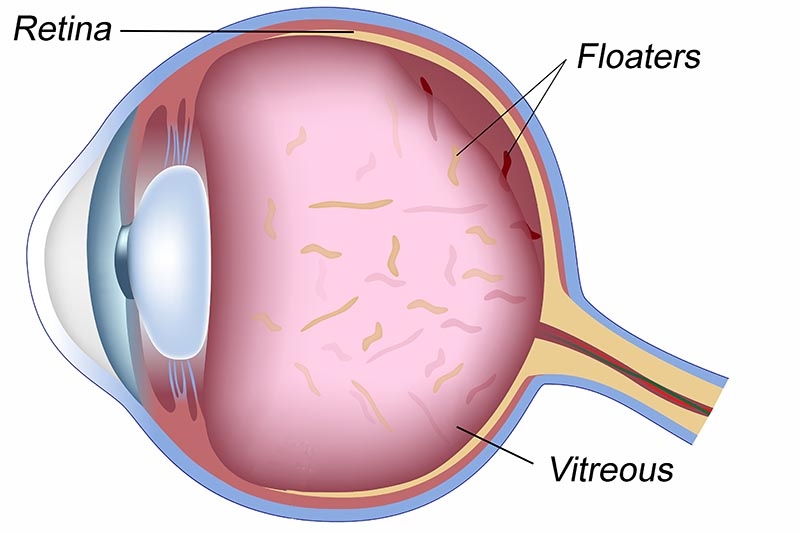
Floaters come from aging of the vitreous. They are relatively predictable, microscopic changes inside the eye that most people may experience over time. If you are experiencing floaters, you are not alone.
🧠 What is the vitreous?
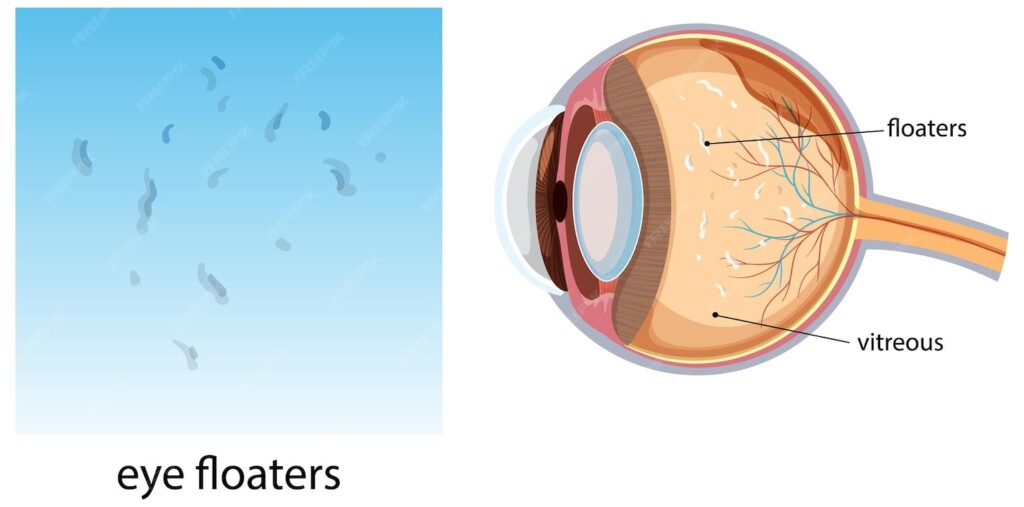
The vitreous humor is a clear, gel-like substance that fills about 80% of the eye—sitting between the lens and the retina.
- Made of ~98–99% water
- Supported by a delicate framework of collagen fibers + hyaluronic acid
- Normally crystal clear, so light passes through unobstructed
In youth, this gel is:
- Smooth
- Firm (like clear gelatin)
- Evenly structured
🔬 What changes with age?
Starting as early as your 40s–50s, the vitreous begins a process called vitreous syneresis.
Step-by-step changes:
1. Liquefaction (the gel breaks down)
- The gel slowly turns more liquid
- Pockets of fluid form inside the vitreous
👉 Think: gelatin melting into water
2. Collagen fibers clump together
- The microscopic collagen strands lose their uniform structure
- They stick together and form strands or clumps
👉 These clumps are what you see as floaters
3. Shadows form on the retina
- Light entering your eye hits these clumps
- They cast tiny shadows on the retina
👉 Your brain interprets these shadows as:
- Spots
- Cobwebs
- Strings
- “Bugs” drifting in your vision
👁️ Why floaters move
Floaters seem to drift or dart because:
- The vitreous is now partly liquid
- The clumps float freely inside the eye
- When you move your eye, they lag behind slightly
👉 That’s why they:
- Move when you look around
- “Swim away” when you try to look directly at them
⚙️ The next stage: vitreous separation
As aging continues, the vitreous can pull away from the retina in a process called:
👉 Posterior Vitreous Detachment
This is extremely common after age 50–60.
During this process:
- The vitreous shrinks
- It detaches from the retina
- This can suddenly create:
- More floaters
- Flashes of light (from retinal traction)
📊 Why this is considered “normal”
Optometrists consider this a natural aging change, not a disease, because:
- It happens in most adults eventually
- It’s usually not harmful
- Vision typically remains unchanged
👉 Many people adapt so well that:
- The brain begins to ignore floaters over time
⚠️ When “normal” can become a problem
Even though this process is common, the same forces that cause floaters can sometimes:
- Pull too hard on the retina
- Create a retinal tear
- Lead to retinal detachment
That’s why eye doctors emphasize:
The process may be normal—but any sudden changes are not
🧭 A Helpful Analogy
“Inside your eye is a clear gel. As you age, that gel becomes more watery and forms tiny clumps. Those clumps float around and cast shadows, which is what you see as floaters.”
💡 Keep in Mind
- Floaters = tiny clumps in an aging vitreous gel
- Caused by natural structural breakdown over time
- Usually harmless—but new or sudden changes should always be checked
How Urgent Are Floaters?
American Academy of Optometry guidance is very consistent:
- Same-day or urgent exam is recommended for new symptoms
- Ideally within 24–48 hours if sudden onset occurs
- Call Eye Department at 503-227-0573 to schedule your medical eye exam. We prioritize same day appointments for patients experiencing floaters.
Eye Department Standard of Care:
- Careful examination of the retina.
- Wide field fundas imaging and/or Ocular Coherence Tomography (OCT) – Non invasive imagine
- Early detection = high chance of saving vision
- Delay = risk of permanent damage
🚨 What warning signs or symptoms should require immediate eye care?
- Sudden increase in floaters (especially a “shower” of spots)
- Flashing lights (like lightning or camera flashes)
- Loss of side (peripheral) vision
- You notice shadows, vision loss, or a what’s commonly describe as a “curtain”
- Sudden blurry or distorted vision
- Call 503-227-0573 or email hello@eyedepartment.com